

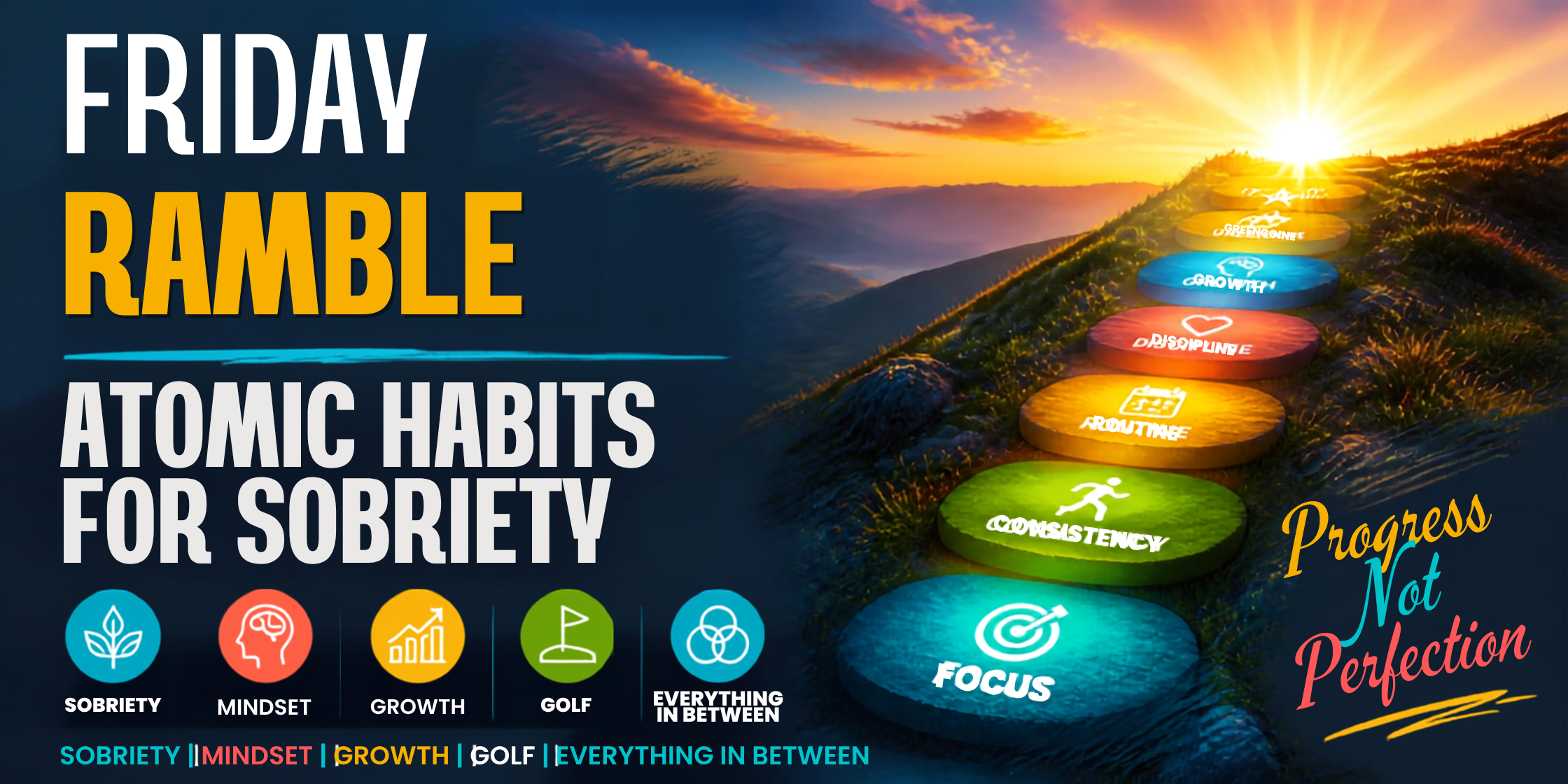
“You do not rise to the level of your goals. You fall to the level of your systems.” — James Clear, Atomic Habits.
This week I have mostly been thinking about golf, which is no real difference to most weeks at the moment, but something has shifted for me lately that also ties directly into sobriety, and I promise I will get to that part in a minute, but first I need to get the golf bit out of my system because apparently this strange little game now owns a large part of my brain and most of my emotional stability.
Without boring you for another week about the ins and outs of my terrible putting at the moment, although I could probably write a whole book called Sober On A Drunk Planet: Three Putts And Other Spiritual Lessons, I have realised over the last six months that I was focusing on the wrong thing. I was playing rounds of golf and attaching everything to the result, which meant by the end of last season I was directly linking each scorecard to my progress, my self-worth, and unintentionally, my own happiness. This is not a healthy way to live, especially when golf is a sport that can make you feel like Tiger Woods on the first hole and a confused goat holding a stick by the fourth.
Cue a bit of soul-searching, a continued desire to pursue this impossible game, and listening to Atomic Habits again, which led me back to something I already knew from sobriety but had somehow forgotten with golf. Results are not the thing you control. Processes are. You can want the handicap, the tournament score, the better swing, the calm mind, the improved putting stroke and the ability to walk off the eighteenth without wanting to launch your putter into a nearby lake, but wanting those things does not create them. The only thing that gives you a chance is the boring stuff you repeat each day when nobody is watching.
When I got to +1 handicap a few years ago, it was largely because the book empire, which still feels mad to write, gave me more time to pursue the game I love, and as a result of playing almost every day, I improved. It was not some perfectly designed performance programme. It was not elite planning. It was not me sitting with a whiteboard, wearing a gilet, speaking like a LinkedIn productivity coach. I simply played a lot, loved it, and got better because time on task still matters.
Then, because I wanted to chase perfection, which is always a dangerous place for me to go because I am very capable of turning a hobby into a psychological war zone, I got myself a coach, changed clubs numerous times, tinkered with everything, and my process became simple but ineffective. See my coach, practice a bit, play a lot, get annoyed, change something, repeat. The problem was that my practice normally just meant playing golf, and although playing is obviously important, if you want to get really good at this game you need to practise more than you play because that is where the skills are actually developed.
Listening to Atomic Habits gave me one of those lightbulb moments that makes you slightly annoyed because the answer was obvious, but you were too busy being emotionally battered by your own expectations to see it. The results do not lie. My golf has gone backwards since a few years ago, and that is fine. Life is not a straight line to success, and golf might be the most humbling sport ever invented for the ego, because one day you think you have cracked it, and the next day the game reminds you that you are one slightly open clubface away from questioning every decision you have ever made.
So I needed a different approach, and it is one that aligns very closely with getting sober and staying sober. I needed to focus on the process rather than the result. In other words, I needed a proper plan to improve my golf, while largely letting go of the need to judge myself every time I play under tournament conditions. The score still matters because golf is a scoring game and I am not pretending to be some floating monk who does not care about results, but the score cannot be the thing deciding whether I am progressing, whether I am happy, or whether I am worthy of continuing.
This is where Atomic Habits helped me re-understand the importance of tiny habits, repeated consistently, because the small stuff you do each day eventually becomes the big stuff people see later. So at the moment, I practise three times a week and either play eighteen holes or nine holes depending on fatigue. I train in the gym four times a week, although a shoulder injury from Pilates is keeping me out of action until I can load weight again, and yes, a 110kg man on a Pilates reformer bench is a sight to be seen, but after four weeks I am becoming slightly more elegant coming off the machine, which is progress I will absolutely take at this stage of life.
I have added Pilates to help with my core and rotation, along with Gyrotonics, and I am really trying to change the way I approach my golf game rather than just hoping that more golf magically fixes everything. More importantly, it has massively helped my happiness, because I am not fixating on results at the moment. I am trusting the process of improvement, which we all know from sobriety is never a straight line. It goes well, then it does not. We go back to the drawing board. We try again with a bit more information. It goes well again. Then we slip, wobble, lose confidence, learn something new, and keep going.
That is sobriety in a nutshell. You do not get sober by staring at the giant result of forever and terrifying yourself into thinking you need to solve the rest of your life today. You get sober by staying sober for twenty-four hours, and then you build the habits and processes that make those twenty-four hours possible. The meetings, therapy sessions, emails, podcasts, books, exercise, better sleep, different people, safer places, better routines, more honesty, and whatever else you are doing to keep yourself from going back to the old chaos. The result is managed through the process. The life changes because the day changes.
My golf is the same this time. I am trying to do the daily habits that give me a chance of getting to a new level, and the results are no longer ruining my days or weeks because I have stopped treating every scorecard like a judge sentencing me as a failure. I still track everything and use it to guide my practice, so it is useful feedback, but it is not a weapon anymore. It tells me what needs attention. It does not tell me who I am.
That difference has been massive for me. I get to go to a beautiful part of the UK most days, spend time on the practice range, work on my chipping, work on my putting, train in the gym, and try to find some consistency again. I love training. I love Pilates, even if it tried to murder my shoulder. I love how hard golf is because it feels impossible, and although I am not yet seeing the results I want on paper, I can see a massive change in a short amount of time in how my game is developing and how I am managing myself around it.
Sobriety taught me this before anything else did. It taught me that the habits you repeat each day compound over time, even when it does not look like anything magical is happening. Those habits allowed me to stay sober, rebuild my life, write books, build a business, play golf, and most importantly, remain free from alcohol and drugs for 8.7 years. None of that happened because I woke up one day with a perfect result. It happened because I kept repeating the boring, unglamorous, life-saving things long enough for my life to start changing.
The worst thing you can do with sobriety is expect a result from it too quickly, because then you start asking why life is not perfect after seven days, why you still feel anxious after a month, why your relationships are not magically healed, why your confidence has not suddenly appeared, or why you still feel a bit lost even though you have stopped drinking. The best thing you can do is make sure you stay sober today and build the habits around you that make that possible, because over time you will look back and realise that the daily decision not to drink was quietly becoming the best decision of your life.
So this week’s Ramble is a reminder to focus on the process over the result, whether that is sobriety, golf, business, health, relationships, money, or whatever else you are trying to improve. Goals are useful because they give us direction, but the process is where the real work lives. James Clear first published Atomic Habits in 2018, and it does not surprise me that the book is still everywhere, because it keeps pointing people back to the thing most of us want to avoid when we are desperate for change. The small daily reps matter more than the emotional obsession with the final outcome.
If your sobriety is already grounded in your day-to-day life, while also remembering that we can never get complacent, then maybe the question is not what huge new result do you want next, but what small daily habits could you simplify or strengthen to move towards the life you want. That might be your health. It might be your confidence. It might be your finances. It might be your relationships. It might be building a life that feels so full and meaningful that alcohol has nowhere useful to fit anymore.
At the moment, I am trying to fall in love with the process again, and it has been such a big help to my happiness because I am not letting results dictate this part of the journey. I am not ignoring the results, because that would be delusional, and I have done enough delusional things in my life already, but I am using them as feedback rather than punishment. I am doing the reps, trusting the tiny habits, and reminding myself that improvement is often happening long before it becomes obvious to everyone else.
Sobriety was the first place I learned that. Golf is simply reminding me of it again, with slightly more expensive equipment and more three-putts than I would currently like.
Be the first to hear our Weekly Friday Ramble about life, sobriety and everything in between:
Check out the latest posts:
- Common Symptoms of Alcohol Dependence Withdrawal and When to Get Urgent Help
- Why Am I Lazy? Maybe You’re Just Living the Wrong Life
- How To Think Positively When Life Feels Against You
- Atomic Habits for Sobriety: Golf, Habits and the Power of Process
- What Sober Celebrities Teach Us About Relapse — And Why Sobriety Still Wins