

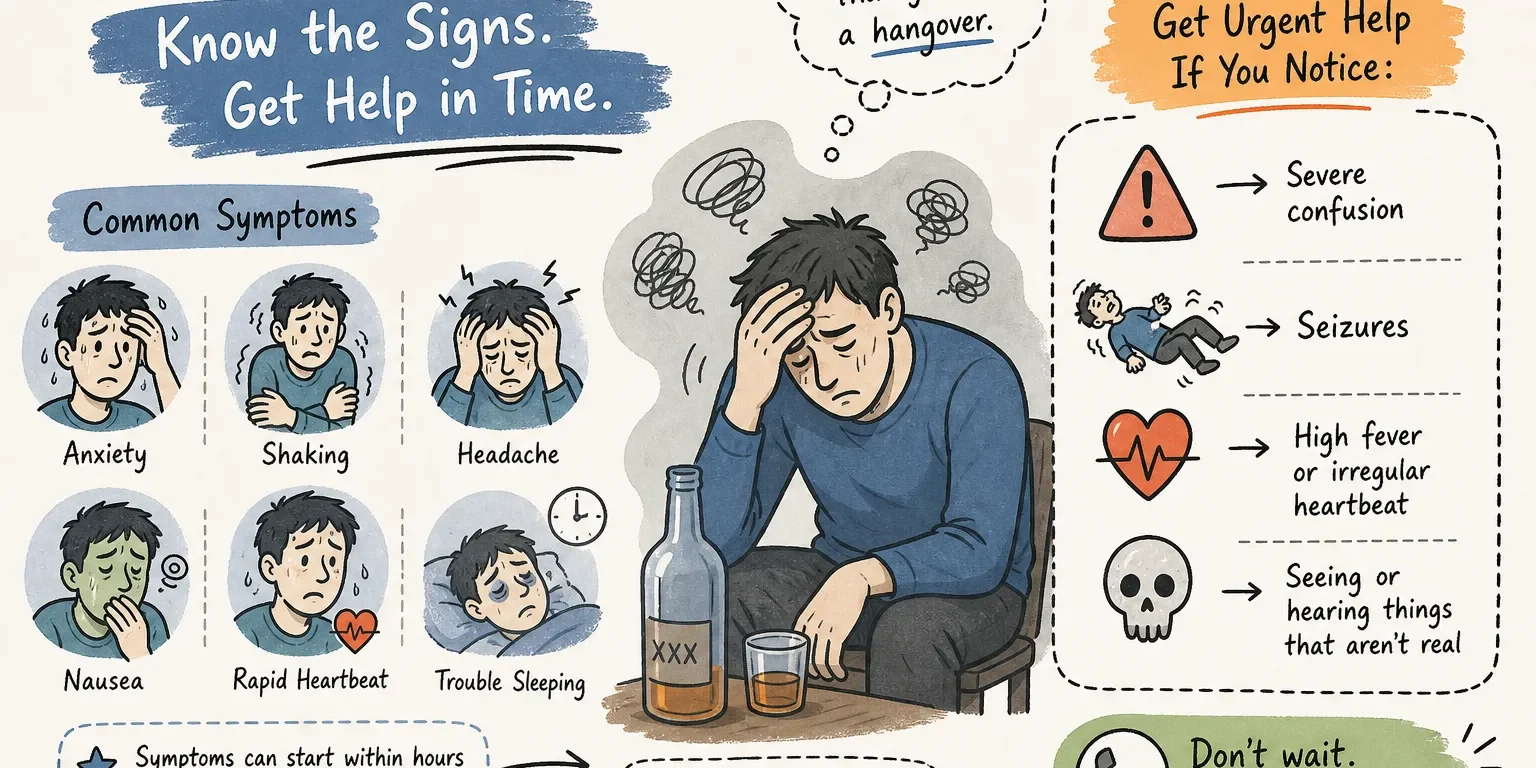
Common Symptoms of Alcohol Dependence Withdrawal and When to Get Urgent Help
If you have become physically dependent on alcohol, stopping suddenly is not simply a case of enduring a horrible hangover for a few days and waiting for it to pass. For some people, alcohol withdrawal can become a genuine medical emergency, which is why I want to make something very clear before going any further: if you drink heavily or regularly enough that you think your body may be dependent on alcohol, please do not use an article on the internet as your detox plan.
That is not me trying to frighten you into sobriety. I spent years drinking heavily, using cocaine, gambling and generally treating my body like something I had borrowed from somebody I didn’t particularly like, so I understand the temptation to think, “I’ll just stop and deal with whatever happens.” The problem is that once physical dependence has developed, your nervous system may have adapted to alcohol being there, and suddenly removing it can cause far more than sweating, anxiety and a bad night’s sleep.
Alcohol withdrawal syndrome, usually shortened to AWS, happens when somebody who has developed alcohol dependence substantially reduces or stops drinking. The brain has adapted to alcohol’s depressant effects over time, so when alcohol is suddenly removed, the nervous system can become overactive. Depending on the level of dependence and the individual, withdrawal can range from unpleasant symptoms such as shaking and nausea through to seizures and delirium tremens.
The NHS warns that it can be dangerous to stop drinking suddenly if you are dependent on alcohol, and advises people experiencing withdrawal symptoms to get medical help before attempting to stop. In the US, alcohol withdrawal is also treated as a potentially serious medical condition, with severe symptoms requiring emergency assessment.
If you are worried about your own drinking, the NHS has useful information on alcohol-use disorder, but if you believe you may already be physically dependent, speak to a doctor, alcohol service or appropriate medical professional before suddenly stopping.
If you think alcohol withdrawal is becoming dangerous
If you are in the UK and somebody has a seizure, becomes severely confused or delirious, develops hallucinations, is visibly shaking, becomes unusually agitated or appears to be in immediate medical danger, call 999 or go to A&E. The NHS specifically lists severe shaking, confusion, hallucinations and seizures as reasons to seek emergency care.
If you are in the US and somebody is having a medical emergency, including severe alcohol withdrawal, call 911 or go to the nearest emergency department. SAMHSA advises calling 911 or going to the nearest emergency room when somebody is in immediate danger or experiencing a medical emergency.
If you are in the US and need help finding treatment for alcohol or substance use, SAMHSA’s National Helpline is available 24 hours a day on 1-800-662-HELP (4357) and provides free and confidential treatment referral and information. If you are struggling with a mental-health, suicide or substance-use crisis, you can also call or text 988 for 24/7 crisis support.
Why can stopping alcohol suddenly be dangerous?
Alcohol is a central nervous system depressant, which basically means it slows certain processes in the brain and nervous system. When alcohol is used heavily and consistently, the brain tries to compensate for those effects and maintain some form of balance.
Imagine driving a car with one foot permanently pressing down on the brake while your other foot gradually pushes harder on the accelerator to keep the car moving. If you suddenly remove the brake but the accelerator is still pressed down, things can become chaotic very quickly.
That is a simplified way of thinking about alcohol withdrawal. Once alcohol is removed, the nervous system can remain in a highly excitable state, which can produce shaking, sweating, anxiety, increased heart rate, agitation and, at the severe end of the spectrum, seizures or delirium.
This is one of the reasons I don’t particularly like moralising around addiction. Once physical dependence is involved, telling somebody to “just stop drinking” can be completely inappropriate advice. Addiction has psychological, behavioural and social elements, but dependence can also involve very real physiological changes that need to be respected.
Current UK clinical guidance warns that moderate or severe alcohol dependence can produce acute alcohol withdrawal syndrome when alcohol is abruptly stopped or substantially reduced, and serious complications can include seizures, delirium tremens and Wernicke’s encephalopathy.
Who is more likely to experience severe alcohol withdrawal?
Not everybody who stops drinking will experience severe withdrawal, and plenty of people will stop alcohol without needing medically assisted detox. The problem is that you cannot reliably assess your own risk simply by looking at whether you still have a job, whether other people think you “look like an alcoholic,” or whether somebody else drinks more than you.
Risk is higher in people with a history of severe withdrawal, particularly anybody who has previously experienced withdrawal seizures or delirium tremens. Long-term heavy drinking, older age, dehydration, electrolyte problems, other physical health conditions and concurrent substance use can also increase the risk of severe withdrawal.
The important point is that alcohol dependence is not a competition. I spent years using the fact that somebody else was worse than me as evidence that I couldn’t possibly have a serious problem, which is an excellent strategy if your goal is to avoid dealing with your own behaviour for as long as possible.
What matters is what alcohol is doing to your body and whether your body has started depending on it.
Early symptoms of alcohol dependence withdrawal
Alcohol withdrawal symptoms can begin within hours of reducing or stopping alcohol, although the exact timing and severity vary considerably between individuals. The NHS says withdrawal symptoms can begin within around 6 to 12 hours of the last drink, while Cleveland Clinic gives a broader range of around 6 to 24 hours.
Common early symptoms can include shaking or tremor, sweating, nausea, vomiting, headaches, difficulty sleeping, anxiety, agitation, restlessness and an increased pulse. Some people describe feeling incredibly unsettled without being able to explain exactly what feels wrong.
This is also where things can become confusing because early alcohol withdrawal can look a lot like a particularly awful hangover.
If you have spent enough mornings waking up after drinking, you probably know the familiar routine of dry mouth, nausea, anxiety, sweating and wondering why you thought ordering another round at midnight was such a magnificent idea. Withdrawal symptoms, however, can intensify rather than gradually improve, particularly in somebody whose body has become dependent on alcohol.
The safest approach is not to try to diagnose the difference yourself if dependence is a possibility. If you are experiencing shaking, sweating, vomiting, significant anxiety or other symptoms after reducing alcohol and you have been drinking heavily or regularly, get medical advice.
Moderate alcohol withdrawal and hallucinations
As alcohol withdrawal becomes more severe, the shaking, sweating, anxiety and agitation can become much more pronounced. Confusion can develop, and some people experience hallucinations.
Alcohol-related hallucinations can involve seeing, hearing or feeling things that are not actually there. Somebody may hear voices, see objects or movement that nobody else can see, or experience sensations such as something crawling across their skin.
This is not something I would recommend trying to ride out on the sofa while repeatedly Googling whether you are going to be alright.
Hallucinations during alcohol withdrawal require medical assessment because they can be part of escalating withdrawal, and they need to be distinguished from delirium tremens and other possible medical causes.
The difficult thing about alcohol withdrawal is that somebody can still be talking, walking around and appearing reasonably coherent while their condition is becoming more serious. Feeling “not too bad” at one particular moment does not guarantee that things cannot deteriorate later.
Alcohol withdrawal seizures
Alcohol withdrawal can cause seizures, and they may occur in somebody who has never previously experienced a seizure. Cleveland Clinic notes that seizure risk is highest around 24 to 48 hours after the last drink in severe or complicated withdrawal.
You can read more about alcohol withdrawal and withdrawal seizures through Cleveland Clinic, but the practical message is much simpler: a seizure associated with alcohol withdrawal requires urgent medical attention.
If somebody has a seizure, call 999 in the UK or 911 in the US.
Do not try to physically restrain them, and do not put anything into their mouth. Make the surrounding area as safe as possible, note how long the seizure lasts if you can, and follow the emergency operator’s instructions.
A previous history of alcohol withdrawal seizures is also important information to give a doctor before attempting to stop drinking again because repeated episodes of withdrawal can increase the risk of complicated future withdrawal.
This is one of those moments where pride has absolutely no useful role. If your body is reacting severely to the absence of alcohol, you have moved well beyond the point where proving how tough you are achieves anything useful.
Delirium tremens: severe alcohol withdrawal
Delirium tremens, often shortened to DTs, is the most severe form of alcohol withdrawal and requires urgent medical treatment. Cleveland Clinic describes DTs as a potentially life-threatening complication of alcohol withdrawal that can involve severe confusion, agitation, hallucinations, sweating, seizures and rapid heart rate.
DTs often develop after the earlier stages of withdrawal rather than immediately. Cleveland Clinic notes that delirium tremens can appear within the first few days after the last drink, with the exact timing varying from person to person.
Symptoms can include profound confusion, severe agitation, hallucinations, heavy sweating, fever, rapid heart rate and somebody becoming disorientated about where they are, what is happening or even what day it is.
The distinction between somebody experiencing hallucinations while remaining aware of their surroundings and somebody experiencing delirium is clinically important, but it is not something friends or family should be trying to diagnose at home.
If somebody withdrawing from alcohol becomes severely confused, delirious, has a seizure or develops rapidly worsening symptoms, call emergency services.
Modern medical treatment has made severe alcohol withdrawal far safer than it once was, but that depends on people actually receiving treatment. This is why articles about quitting drinking need to be careful about presenting sobriety as nothing more than a motivational challenge. For many people, stopping alcohol is straightforward from a medical perspective. For somebody with significant physical dependence, it may not be.
When should you call emergency services?
Severe alcohol withdrawal is an emergency.
In the UK, call 999 or go to A&E if somebody develops severe withdrawal symptoms such as visible shaking, severe agitation, confusion, hallucinations or seizures.
In the US, call 911 or go to the nearest emergency department if somebody appears to be having a medical emergency or is in immediate danger.
Severe confusion or delirium, seizures, serious breathing difficulties, chest pain, rapidly worsening symptoms or somebody becoming dangerously unwell should never be treated as something to simply monitor at home.
If suicidal thoughts are present and there is an immediate danger that you or somebody else may act on them or cannot stay safe, call 999 in the UK or 911 in the US. In the US, you can also call or text 988 for immediate crisis support around suicide, mental health or substance use.
There is sometimes a strange mentality around addiction that asking for medical help somehow means you have failed at stopping. I think the opposite is true. Getting help when you need it is simply making a sensible decision based on the information available to you.
Sobriety gives you plenty of opportunities later to prove how resilient you are. Surviving a dangerous withdrawal without medical help is not a challenge you need to add to the list.
What does medical treatment for alcohol withdrawal look like?
The exact treatment depends on the individual, their level of dependence, their medical history and whether withdrawal is being managed in the community or in hospital.
In the UK, benzodiazepines are used for medically assisted alcohol withdrawal because they help control the overactivity in the nervous system and reduce the risk of serious withdrawal complications. Current UK guidance also covers thiamine supplementation because alcohol dependence can be associated with thiamine deficiency and neurological complications such as Wernicke’s encephalopathy.
Some hospital services use assessment tools such as the CIWA-Ar scale alongside clinical judgement to assess the severity of withdrawal and guide treatment.
In the US, treatment also depends on the severity of withdrawal and the individual patient’s risks. Cleveland Clinic notes that benzodiazepines are commonly used for moderate alcohol withdrawal because they help reduce the risk of seizures and progression to delirium tremens.
You can also read the current UK clinical guidance on alcohol treatment, which covers medically assisted withdrawal, withdrawal complications and thiamine treatment.
The important point for the person reading this article is that the correct medication, dose and treatment setting need to be decided by appropriately qualified medical professionals.
Please don’t read the name of a medication online and decide you can recreate a detox yourself with tablets acquired somewhere else. Medically assisted withdrawal is called medically assisted for a reason.
Getting help before you stop drinking
If you are in the UK and believe you may be dependent on alcohol, speak to your GP, local alcohol service or NHS 111 before abruptly stopping. The NHS specifically advises people experiencing withdrawal symptoms to seek medical help before trying to stop drinking.
If you are in the US, a doctor or addiction treatment service can assess whether withdrawal needs to be medically supervised. SAMHSA’s National Helpline on 1-800-662-HELP (4357) is available 24/7 and can refer people to treatment providers and local support services. You can also use FindTreatment.gov to search for treatment services in your area.
You do not need to wait until your drinking reaches some imaginary level of disaster before asking somebody what the safest way to stop would be.
If the thought has already crossed your mind that stopping alcohol might make you physically unwell, that is enough reason to have the conversation.
Detox is the beginning, not the whole of recovery
Safely getting alcohol out of your body and learning how to live without it are two completely different challenges.
The immediate withdrawal period may pass relatively quickly, but that does not mean everything suddenly becomes easy. Sleep can take time to settle, anxiety may still be present, cravings can return unexpectedly, and the reasons alcohol became such a large part of your life do not vanish simply because your blood alcohol level reaches zero.
This was certainly true for me.
Stopping drinking removed an enormous problem from my life, but it also exposed everything alcohol had been covering up. I had to learn how to deal with emotions without drinking through them, how to spend weekends without planning everything around getting smashed, how to socialise sober, how to handle anxiety, how to rebuild my finances and eventually how to create a life that I actually enjoyed being present for.
That is why I have always believed sobriety needs to become about considerably more than simply counting how many days you haven’t consumed alcohol.
If you are at the beginning of that process, the Sober On A Drunk Planet books were written to help with the part that comes after the alcohol is gone, from understanding triggers and changing habits to rebuilding your mindset and finding out what you actually want your sober life to look like.
There is no one perfect recovery route. Some people use AA, some use SMART Recovery, some work with therapists or alcohol services, some use books and structured education, and plenty of people combine several approaches. What matters is finding enough appropriate support around you that you do not have to rely entirely on white-knuckling your way through difficult days.
Triggers still matter after the physical withdrawal has ended
One of the stranger parts of long-term sobriety is discovering that a trigger doesn’t necessarily disappear simply because you have been sober for years.
Mine can still be sunshine.
There is something about warmth, sitting outside and that old association between summer, pubs, holidays and drinking that occasionally causes a thought to flash through my mind, even though I have been sober for years and have no desire to return to the chaos alcohol created.
I have written a lot about triggers throughout the Sober On A Drunk Planet books because understanding them is one of the practical parts of recovery that becomes important once the immediate physical danger of withdrawal has passed.
The goal isn’t necessarily to create a life where you never think about alcohol again. It is to create enough awareness that a thought doesn’t automatically become a behaviour.
That difference changed my life.
The Friday Ramble: what happens after you get sober?
One of the reasons I started writing the Friday Ramble was because sobriety content can sometimes make recovery look like a destination where everything suddenly becomes peaceful, meaningful and incredibly well organised.
My experience has been slightly different.
Life becomes life again.
There are good weeks, awful weeks, health problems, relationships, money, work, ridiculous golf obsessions, anxiety, confidence, cats, existential crises and all the other things that happen when you stop numbing yourself and actually participate in being alive.
The Friday Ramble is my weekly email about exactly that. Sobriety is always somewhere underneath it because none of my current life would exist without getting sober, but increasingly it is about what happens afterwards and how we build lives we don’t constantly want to escape from.
If you are through the physical withdrawal stage and wondering what you’re supposed to do with yourself now, the Friday Ramble is probably the best place to stay connected with what I am writing and thinking about each week.
FAQ: symptoms of alcohol dependence withdrawal
How quickly can alcohol withdrawal symptoms begin?
Alcohol withdrawal symptoms can begin within hours of somebody substantially reducing or stopping alcohol. The NHS says symptoms can begin within around 6 to 12 hours of the last drink, while other clinical sources describe a typical range beginning within around 6 to 24 hours.
Early symptoms can include sweating, shaking, nausea, anxiety, agitation and sleep disturbance.
How long does alcohol withdrawal last?
The duration varies depending on the individual, their level of dependence, their health and whether complications occur. The NHS says withdrawal symptoms commonly last around 3 to 7 days, although some symptoms may last longer, particularly after heavy drinking.
The important thing is not to use a generic timeline as reassurance that you are definitely safe. If symptoms are severe or worsening, seek medical help.
Can I safely detox from alcohol at home?
Some medically assisted withdrawals can be managed outside hospital, but whether this is appropriate requires proper assessment.
If you think you are physically dependent on alcohol, speak to a GP, alcohol treatment service or NHS 111 in the UK, or a doctor or appropriate treatment service in the US, before suddenly stopping.
Anyone with a history of severe withdrawal, seizures or delirium tremens should tell the medical professional assessing them because those factors can substantially increase risk.
What is the difference between a hangover and alcohol withdrawal?
There can be considerable overlap between the symptoms, particularly nausea, anxiety, sweating, headaches and shaking.
Alcohol withdrawal occurs because a dependent nervous system is reacting to the reduction or absence of alcohol, whereas a hangover is caused by the after-effects of drinking.
If symptoms are becoming more severe after stopping alcohol, particularly if there is significant shaking, confusion, hallucinations or any history of withdrawal complications, do not assume it is simply a bad hangover.
Are hallucinations during alcohol withdrawal dangerous?
Hallucinations can occur during alcohol withdrawal and require medical assessment, particularly because severe withdrawal can progress to delirium tremens.
If somebody is hallucinating, severely confused or becoming rapidly more unwell during alcohol withdrawal, seek urgent medical attention.
When should I call emergency services because of alcohol withdrawal?
In the UK, call 999 or go to A&E for severe withdrawal symptoms such as seizures, confusion, hallucinations or severe visible shaking.
In the US, call 911 or go to the nearest emergency department if somebody is having a medical emergency or appears to be in immediate danger.
If you are in the US and experiencing a mental-health, suicide or substance-use crisis, call or text 988.
One final thought
I have written a lot over the years about the benefits of giving up alcohol, and I genuinely believe stopping drinking was the single most important decision I ever made.
It gave me my health back. It gave me relationships back. It gave me money, time, writing, golf, purpose and a life that I couldn’t have imagined when I was permanently hungover and wondering why everything felt so difficult.
But I would never tell somebody with alcohol dependence to simply stop drinking tomorrow because it worked for me.
There is a difference between encouraging somebody to change their relationship with alcohol and pretending that physical alcohol dependence isn’t a serious medical condition.
If your drinking has reached the point where you experience withdrawal symptoms when alcohol wears off, make the first sober decision a sensible one and get appropriate medical advice before stopping.
Then, once the alcohol is safely out of your system, the interesting work begins.
Because getting sober isn’t really about spending the rest of your life thinking about the drink you gave up. It is about finally getting the chance to find out what you can do without it controlling you.
Want some easy reading for what 7 sober secrets look like that nobody talks about? Start here.