

A sobriety journal can be one of the most useful tools you use when you stop drinking, but only if it does more than ask you to write down a few feelings and hope for the best.
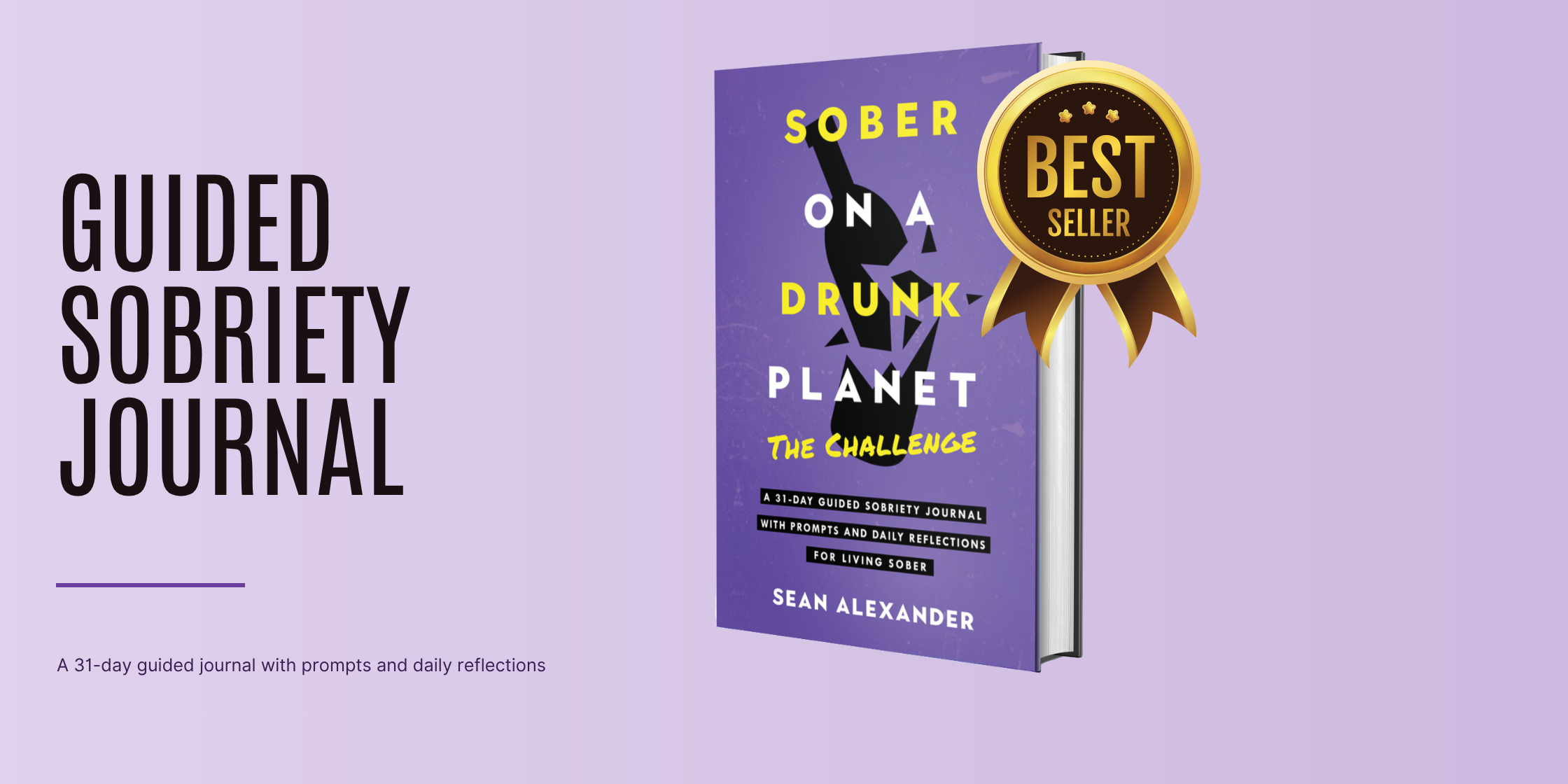
That is why Sober On A Drunk Planet: The Challenge was created.
It is not just a blank notebook. It is a 31-day guided sobriety journal and alcohol recovery workbook with daily reflections, morning and evening prompts, trigger work, gratitude practice, accountability, financial awareness, and enough uncomfortable questions to make you look at alcohol properly instead of dancing around the truth like it is a suspicious wet patch on the kitchen floor after a night out.
Because stopping drinking is not just about removing alcohol.
It is about understanding why alcohol had so much control in the first place.
Why Use A Sobriety Journal?
Most people do not drink in a vacuum. Alcohol is usually attached to feelings, habits, places, people, memories, stress, boredom, anxiety, celebrations, commiserations, loneliness, confidence, and the strange social belief that every human event requires a drink in your hand.
A hard day at work? Drink.
A good day at work? Drink.
A date? Drink.
A break-up? Drink.
A wedding, funeral, birthday, Christmas, sunny afternoon, football match, golf trip, airport lounge, Friday night, or random Tuesday because you “deserve it”? Drink.
That is why a sobriety journal can be so powerful. It slows the pattern down. It helps you notice what is actually happening before you automatically reach for alcohol. It creates space between the trigger and the response.
As Viktor Frankl said, “Between stimulus and response, there is a space. In that space lies our freedom and power to choose our response.”
That space is where sobriety starts to become real.
If you have been living in the drink → regret → repeat loop for years, you may not even know what your triggers are anymore. They have become normal. You might think you drink because it is Friday, but underneath that could be stress, anxiety, low self-worth, resentment, loneliness, habit, people-pleasing, fear of missing out, or simply not knowing what else to do with yourself.
A guided sobriety journal helps you stop guessing.
It gives you somewhere to tell the truth.
What Makes The Challenge Different?
There are plenty of alcohol-free challenges, sobriety journals, and recovery workbooks out there. Some are useful. Some are basically blank pages with a motivational quote at the top and enough white space to make you feel like you accidentally bought expensive homework.
The Challenge is different because it was designed to be both reflective and practical.
It is a 31-day guided sobriety journal built around three foundations from the Sober On A Drunk Planet series: self-awareness, positive action, and intuition. The idea is simple. First, you understand yourself better. Then you take healthier action. Then, through repetition, those healthier choices become more automatic, which is where the sober compound effect starts doing its magic.
The journal is designed to fit into real life. You keep it by your bed, complete the morning prompts when you wake up, and return to the evening prompts before you go to sleep. The daily reflections are intentionally short and easy to digest, so you can start the day on a sober footing without needing to disappear into a monastery, quit your job, or become someone who speaks only in wellness quotes.
The point is not perfection.
The point is awareness.
Because awareness gives you a choice.
A Sobriety Workbook With Daily Prompts
One of the reasons The Challenge works as a sobriety workbook is that it gives you repeated daily prompts rather than leaving you to stare at a blank page wondering what on earth to write.
Every morning, you are asked to check in with how you feel, what you are grateful for, what may challenge your sobriety, and how you can stay sober today. That structure matters because it gets you thinking ahead rather than waiting until you are already triggered, tired, angry, or standing in the supermarket pretending you are only in the wine aisle because it has better lighting.
The evening journal then brings you back to yourself at the end of the day. You reflect on how you feel, what you could have done better, whether you felt triggered to drink, what triggered you, and what you did well to maintain your sobriety.
Those questions might sound simple, but they are doing important work. They help you connect your thoughts, emotions, behaviours, and outcomes. They help you spot patterns. They help you see which people, places, feelings, and situations make sobriety harder. They also help you celebrate the small wins, which is something many people forget to do when they stop drinking.
And those small wins matter.
Every sober day is evidence.
Every time you pause instead of react, you build trust in yourself.
Every time you notice a trigger and choose differently, you weaken the old drinking autopilot.
30+ Sobriety Journal Prompts To Help You Think Differently
People often search for sobriety journal prompts because they know writing might help, but they do not know where to begin.
That is completely normal.
It is hard to write honestly about your drinking when your mind has spent years justifying, minimising, laughing off, or avoiding the truth. That is why a guided sobriety journal can be far more useful than a blank notebook. The right questions pull things out of you that you did not even realise were there.
The Challenge includes more than 30 days of sobriety journal prompts, daily reflections, and questions designed to make you look at alcohol, habits, triggers, emotions, money, health, and your future differently.
Some of the core prompts include:
What am I feeling today?
What am I grateful for?
What might challenge my sobriety today?
How can I stay sober today?
What could I have done better today?
Did I feel triggered to drink today?
What triggered me?
What did I do well to maintain my sobriety?
What is really going on for me when I decide to get drunk?
What have I learned about myself over the past 31 days?
What do I understand about my triggers now that I did not know before?
What changes have I noticed mentally, physically, emotionally, spiritually, financially, and in my relationships?
These are not fluffy questions. They are sober mirror questions. And sometimes sober mirror questions are exactly what you need because alcohol has a wonderful talent for helping you avoid the mirror entirely.
As the book says, “if it doesn’t challenge you, it doesn’t change you.”
Why 31 Days?
A 31-day sobriety challenge gives you enough time to experience life without alcohol, build a daily routine, and start noticing changes without making the whole thing feel impossibly huge.
Most people can understand 24 hours.
One day sober.
Then another.
Then another.
That is how this journal is designed to work. It does not ask you to solve the rest of your life on day one. It asks you to focus on today, reflect honestly, and repeat the process.
That repetition is powerful because sobriety is not built from one dramatic decision. It is built from daily reps.
Morning reflection.
Sober action.
Evening honesty.
Sleep.
Repeat.
After 31 days, you are not just counting sober days. You have a written record of what happened during them. You can look back and see what challenged you, what helped you, what changed, what surprised you, and what you learned about yourself.
That is far more useful than just saying, “I didn’t drink for a month.”
It becomes evidence that you can change.
Understanding Your Triggers
One of the most important parts of any sobriety workbook is trigger awareness.
Triggers are not always obvious. Some people are triggered by pubs, holidays, certain friends, Friday nights, weddings, football, sunshine, work stress, airports, loneliness, payday, family arguments, or that strange emotional discomfort that appears when life goes quiet and there is nothing left to numb.
The evening journal in The Challenge asks whether you felt triggered to drink and what triggered you. Over time, that question helps you build a clearer picture of your relationship with alcohol.
Maybe you notice that you feel most vulnerable after work.
Maybe Sunday boredom is harder than Friday night.
Maybe certain people make sobriety feel fragile.
Maybe you do not actually crave alcohol as much as you crave relief, confidence, connection, attention, escape, or silence from your own thoughts.
Once you understand the real trigger, you can start building a better response.
This is one of the biggest reasons journaling helps in sobriety. It gives you the data. And once you have the data, you can stop pretending your drinking “just happens.”
The Finance Tracker: Seeing The Real Cost Of Drinking
Alcohol does not just cost you the price of the drink.
It costs taxis, takeaways, cigarettes, drugs, rounds you cannot afford, lost productivity, missed opportunities, and sometimes a complete financial disaster dressed up as a “good night out.”
The Challenge includes a finance tracker to help you calculate what alcohol has really been costing you. At the beginning, you estimate what you would typically spend in a week. At the end of the 31 days, you calculate what that means over a month, six months, a year, five years, and ten years.
This matters because many people underestimate the financial damage of drinking.
You might think you spend £40.
Then you add the food, the taxi, the extra rounds, the cigarettes, the drugs, the hangover takeaway, the missed work, the impulse purchases, and suddenly your “few drinks” looks like a small business with terrible accounting.
Seeing the numbers in front of you can be uncomfortable, but discomfort can be useful.
Sometimes you need the shock calculation.
Not to shame yourself, but to wake yourself up.
Final Reflections: Seeing How Far You Have Come
At the end of the 31 days, The Challenge asks you to reflect on what has changed mentally, physically, emotionally, spiritually, financially, and in your relationships. It also asks what you are most proud of, what you have learned about yourself, and what you now understand about your triggers.
This final reflection is important because people often miss their own progress.
You may feel like not much has changed because your life is still your life. You still have work, bills, responsibilities, awkward people, family stuff, health stuff, and days where you feel a bit like a confused pigeon walking around a supermarket car park.
But when you write it down, you see the evidence.
You slept better.
You saved money.
You had less anxiety.
You got through a trigger.
You went to bed sober.
You woke up without regret.
You kept a promise to yourself.
That is not small.
That is how confidence is rebuilt.
Is This The Right Sobriety Journal For You?
The Challenge is for you if you want a practical sobriety journal that gives you structure rather than leaving you alone with a blank page.
It is for you if you are tired of the drink → regret → repeat loop and want to understand what is really going on beneath your drinking.
It is for you if you want daily sobriety journal prompts, short reflections, trigger work, gratitude practice, a finance tracker, and a simple morning and evening routine to help you stay focused for 31 days.
It is for you if you are sober curious, newly sober, returning after a slip, or simply ready to take a serious alcohol-free break and actually learn from it rather than white-knuckle your way through while secretly counting down to the next drink.
It is also for you if you have read Giving Up Alcohol or 3 Sober Steps and want something more interactive to help you apply the ideas in real life. The book is designed as a standalone journal, but it also works well alongside the earlier books in the series.
Sobriety Is Not Just About Not Drinking
The real point of a sobriety journal is not to make you better at journaling.
The point is to help you become more honest, more aware, and more able to choose a life that alcohol no longer controls.
Because sobriety is not just about removing alcohol. It is about getting your time, energy, money, health, confidence, and self-respect back. It is about learning what your triggers are, what your emotions are trying to tell you, what patterns need to change, and what kind of life you want to build instead.
The Challenge gives you 31 days of structure to begin that process.
Not perfectly.
Not dramatically.
Just honestly, one day at a time.
And sometimes that is exactly where everything starts.
Read The Challenge
If you are looking for a sobriety journal, sobriety workbook, or 31-day alcohol-free challenge with daily reflections and more than 30 sobriety journal prompts, Sober On A Drunk Planet: The Challenge is here to help you start writing your way into a better life.
Read The Challenge here:
The Challenge
You can also explore the full Sober On A Drunk Planet series here:
SOADP Series
A sobriety journal is a place to reflect on your thoughts, feelings, triggers, habits, and progress as you stop drinking or stay sober. A guided sobriety journal gives you prompts and structure so you are not left staring at a blank page wondering what to write.
The Challenge is a 31-day guided sobriety journal and alcohol recovery workbook with morning and evening prompts, daily reflections, trigger work, gratitude practice, financial tracking, and final reflections to help you understand your relationship with alcohol.
It is both. It works as a sobriety journal because it gives you space to reflect each day, and it works as a sobriety workbook because it includes structured exercises, prompts, finance tracking, trigger awareness, and guided reflections.
The Challenge includes more than 30 days of sobriety journal prompts, with daily morning and evening questions, daily reflections, and final review prompts to help you understand what changed over the 31 days.
It is best for anyone who wants structure while stopping drinking or taking an alcohol-free break. It can help people who are sober curious, newly sober, returning to sobriety, or looking for a practical daily tool to support their alcohol-free life.
Yes. Each evening, you are asked whether you felt triggered to drink and what triggered you. Over time, this helps you spot patterns around people, places, emotions, situations, and habits that may be connected to drinking.
No. The Challenge can be used on its own. However, it also works well alongside Giving Up Alcohol and 3 Sober Steps if you want more background, practical sobriety tools, and deeper understanding of the Sober On A Drunk Planet approach.