

Getting sober is one thing. Learning how to live sober by embracing the rollercoaster that is emotional sobriety is something else entirely.
In early sobriety, the main focus is usually alcohol itself. How do I stop drinking? How do I get through the weekend? How do I deal with cravings? How do I explain this to people? How do I get through another day without going back to the same old cycle? Those questions matter, because physical sobriety has to come first. If alcohol is still controlling your decisions, weekends, money, relationships, mood, and self-respect, then removing it is the obvious first step.
But after a while, many people discover something uncomfortable.
Alcohol was not the only problem.
It was the thing covering the problem.
This is where the idea of emotional sobriety becomes important. Emotional sobriety is not just about whether you drink or not. It is about how you handle life when alcohol is no longer there to numb, soften, distract, inflate, excuse, or destroy everything. It is about what happens when stress hits, when insecurity appears, when someone criticises you, when a relationship becomes difficult, when old shame rises up, when boredom feels unbearable, or when your own mind starts talking to you in ways you would never speak to another human being.
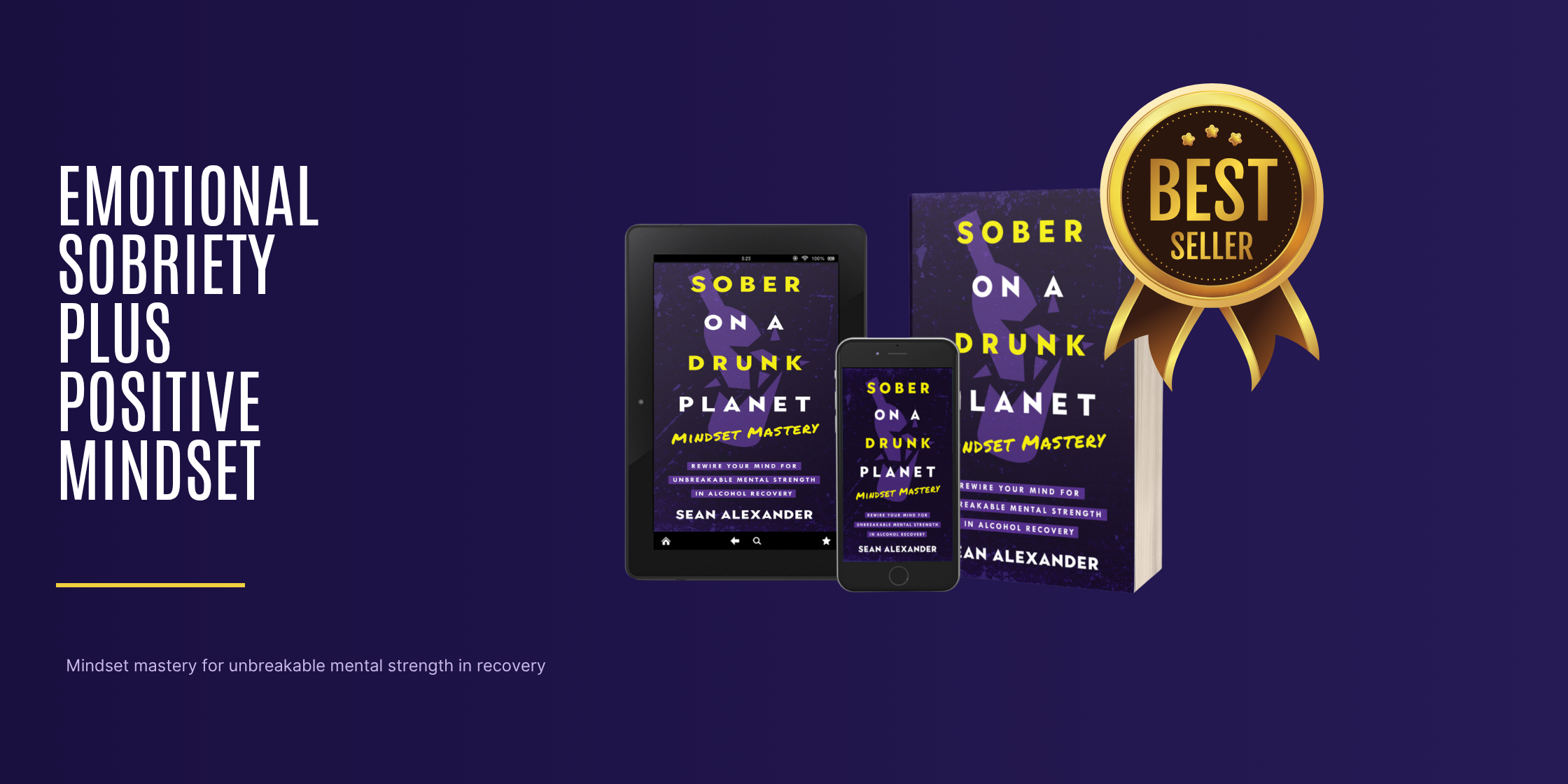
That is the space Sober On A Drunk Planet: Mindset Mastery was written for.
Because stopping drinking gives you a chance to rebuild your life, but your mindset determines whether you actually do.
What Is Emotional Sobriety?
Emotional sobriety means developing the ability to feel, think, respond, and live without being constantly controlled by your emotions, old patterns, ego, fear, resentment, insecurity, or the need to escape yourself.
It does not mean you become calm all the time. It does not mean you never get angry, anxious, jealous, sad, lonely, ashamed, or overwhelmed. It definitely does not mean you turn into one of those people who floats around in linen trousers telling everyone they are “holding space” while secretly annoying every person in the room.
Emotional sobriety means you stop letting every feeling become a crisis.
It means you can feel angry without blowing up your life. You can feel anxious without reaching for alcohol. You can feel rejected without collapsing into self-hatred. You can feel bored without creating chaos. You can feel uncomfortable without immediately looking for a way to numb it. You can have a difficult day without deciding the whole of sobriety has failed and you might as well press the big red “fuck it” button.
In physical sobriety, alcohol leaves your body.
In emotional sobriety, alcohol slowly loses its role as your emotional escape route.
That distinction matters because many people stop drinking and then wonder why life still feels hard. They assume sobriety should immediately make them peaceful, confident, happy, productive, forgiving, patient, emotionally mature, and suddenly able to assemble flat-pack furniture without wanting to throw a small Allen key through a window.
But sobriety is not magic.
Sobriety gives you clarity.
What you do with that clarity is the next part of recovery.
Emotional Sobriety And AA
The phrase emotional sobriety is often connected with AA and Bill Wilson, one of the co-founders of Alcoholics Anonymous. In recovery circles, emotional sobriety is usually understood as the deeper emotional and spiritual work that comes after simply putting down the drink. It is the part of recovery where a person learns to live with more balance, humility, honesty, responsibility, and emotional maturity.
That is why people search for terms like emotional sobriety AA, Bill Wilson emotional sobriety, what is emotional sobriety in AA, and emotional sobriety meaning. They are not just asking about alcohol anymore. They are asking about the life underneath it.
They are asking why they still feel restless.
Why they still get triggered.
Why relationships still feel difficult.
Why they still compare themselves to others.
Why they still feel resentful, fearful, insecure, or stuck.
Why stopping drinking did not automatically fix the way they think.
This is exactly where mindset work becomes important. Whether you follow AA, another recovery programme, therapy, counselling, coaching, your own spiritual path, or no formal programme at all, the deeper work is often the same: learning how to stop being ruled by the old internal patterns that alcohol used to feed.
Mindset Mastery is not an AA book and does not replace the Twelve Steps, therapy, medical support, or any recovery programme you already use. But it does speak directly to the same wider question: how do you build a healthier mind in sobriety?
Why Mindset Matters In Recovery
Alcohol does not just affect the body. It affects how you see yourself.
For years, drinking can become tied to identity. You might see yourself as the fun one, the chaotic one, the social one, the broken one, the anxious one, the failure, the party animal, the person who always messes things up, or the person who can never stick to anything. Over time, those stories become familiar. And familiar stories can feel true, even when they are destroying you.
When you stop drinking, you do not automatically stop believing those stories.
That is why recovery mindset matters.
A strong recovery mindset helps you challenge the inner critic, question old beliefs, build confidence, take positive action, and slowly create a new identity that is not built around alcohol, shame, regret, or self-destruction.
In Mindset Mastery, the starting point is simple: you are not broken, you are rewiring.
That idea matters because many people enter sobriety carrying years of guilt, shame, embarrassment, and self-hatred. They replay the worst things they did when drinking. They compare themselves to other people. They feel behind in life. They think they have ruined everything. They assume their thoughts are facts. They listen to the inner critic as if it is some wise internal life coach, when really it is often just a tired, frightened, badly programmed voice repeating old nonsense.
Mindset work helps you interrupt that voice.
Not by pretending everything is wonderful.
Not by shouting positive affirmations into the mirror while secretly wanting to headbutt it.
But by learning to notice your thoughts, question them, reframe them, and take action that supports the person you are trying to become.
The Inner Critic In Sobriety
One of the biggest barriers to emotional sobriety is the inner critic.
Most people in recovery know this voice very well. It is the one that tells you you are too far gone, too damaged, too late, too weak, too boring, too broken, too old, too anxious, too ashamed, or too different to change. It is the voice that brings up your past whenever you start making progress. It reminds you of every mistake, every blackout, every argument, every broken promise, every embarrassing message, every relationship you damaged, and every version of yourself you wish nobody had ever met.
The inner critic pretends it is protecting you.
But often, it keeps you stuck.
In drinking, that voice can become part of the negative feedback loop. You feel bad about yourself, so you drink. Then you drink and do something that makes you feel worse about yourself. Then the inner critic gets louder. Then you drink again to escape it. Drink, regret, repeat.
Sobriety breaks the alcohol part of the loop, but the inner critic can still remain.
That is why emotional sobriety requires more than not drinking. It requires learning how to speak to yourself differently, or at the very least learning not to obey every destructive thought that appears in your mind.
A thought is not always the truth.
A feeling is not always an instruction.
A memory is not a life sentence.
You can acknowledge the past without letting it write the rest of your future.
Emotional Sobriety In Relationships
One of the most searched areas around this topic is emotional sobriety in relationships, which makes sense because relationships often reveal how emotionally sober we really are.
It is easy to feel calm when nobody is annoying you.
It is much harder when someone criticises you, ignores you, questions you, misunderstands you, leaves you on read, brings up the past, or does that one tiny thing that somehow activates every unresolved wound from 1998.
Alcohol often damages relationships, but it can also hide the emotional patterns underneath them. People-pleasing, resentment, jealousy, avoidance, codependency, control, fear of abandonment, fear of intimacy, defensiveness, and emotional reactivity can all become clearer once you stop drinking.
This is not always pleasant.
But it is useful.
Emotional sobriety in relationships means learning to pause before reacting. It means communicating honestly rather than exploding or shutting down. It means recognising when your ego is driving the conversation. It means accepting that not every feeling needs to become an argument. It means setting boundaries without needing to be cruel. It means allowing other people to have their own emotions without making them responsible for yours.
Most importantly, it means you stop using alcohol as the third person in every relationship.
When you are sober, you can no longer blame the drink for everything you said. You have to take responsibility. That can feel uncomfortable, but it is also where real change starts.
Positive Thinking In Recovery
Positive thinking in recovery is often misunderstood.
It does not mean pretending everything is fine when it clearly is not. It does not mean ignoring trauma, grief, addiction, depression, anxiety, or the reality of what alcohol has done. It does not mean plastering motivational quotes over pain and calling it healing.
Real positive thinking is not denial.
It is direction.
It is the decision to stop feeding the thoughts that keep you trapped and start practising thoughts that help you move forward. That might sound simple, but in sobriety it can be life-changing because alcohol often trains the mind to expect failure. If you have broken promises to yourself for years, your brain has evidence that you do not follow through. If you have repeatedly tried to stop drinking and gone back, your mind may use that as proof that change is impossible.
But the brain can be trained with new evidence.
Every sober day is evidence.
Every difficult conversation you handle without drinking is evidence.
Every craving you ride out is evidence.
Every time you go to bed sober, wake up clear, exercise, journal, apologise, set a boundary, save money, or do the next right thing, you are giving your mind new material to work with.
This is the sober compound effect.
Small daily reps.
Repeated over time.
A new identity slowly becoming believable.
Recovery Mindset: From Victim To Growth
A major part of Mindset Mastery is the shift from victim mindset to growth mindset.
This is delicate, because many people in recovery have genuinely been through painful, unfair, traumatic, or difficult experiences. Acknowledging that matters. This is not about pretending everything was your fault or using “mindset” as a way to dismiss real suffering.
But there is a difference between recognising what happened to you and letting it control the rest of your life.
A victim mindset says, “This is just who I am. Nothing ever changes. I always mess things up. Life is against me. There is no point trying.”
A growth mindset says, “This has happened, but what can I do now? What can I learn? What choice do I have today? What small action moves me in a better direction?”
That shift is emotional sobriety in practice.
Because sobriety asks you to take responsibility without drowning in shame. It asks you to look at the past honestly, but not live there permanently. It asks you to stop using pain as proof that you cannot change and start using it as information for what needs to heal.
This is hard work.
But staying stuck is hard too.
Going to a job you hate while hungover is hard. Living with anxiety and shame every Monday is hard. Breaking promises to yourself is hard. Feeling like you are wasting your life is hard. Sobriety and mindset work are not easy, but neither is continuing the same destructive loop and hoping it magically becomes less painful.
Emotional Sobriety Exercises And Worksheets
People often search for emotional sobriety worksheets or emotional sobriety exercises because they want something practical. They do not just want an explanation. They want a way to begin.
Here are some simple emotional sobriety exercises that connect closely with the work inside Mindset Mastery.
The first is to catch the thought. When you feel triggered, anxious, ashamed, angry, or overwhelmed, write down the thought driving the emotion. Not the polished version. The honest version. “I am failing.” “They don’t respect me.” “I can’t cope.” “I am boring sober.” “Everyone else is ahead.” “I need a drink.” Once the thought is on paper, it becomes easier to question.
The second is to question the thought. Ask yourself whether it is completely true, whether there is another way to see it, whether you are reacting from fear, shame, ego, or old programming, and what you would say to someone you loved if they had the same thought.
The third is to reframe the thought into something more useful. Not fake. Useful. “I am failing” might become “I am learning how to do this differently.” “I can’t cope” might become “I feel overwhelmed, but I can take one small action.” “I am boring sober” might become “I am still learning what I enjoy without alcohol.” The point is not to lie to yourself. The point is to stop letting the worst version of your thinking run the entire show.
The fourth is to take one positive action. Emotional sobriety is not just thinking differently. It is acting differently. Send the message. Go for the walk. Eat the meal. Turn your phone off. Go to bed. Apologise. Ask for help. Leave the situation. Read something useful. Do the next thing that supports the sober person you are becoming.
This is the kind of daily mindset work that changes recovery from a fragile hope into a lived practice.
Emotional Sobriety Vs Physical Sobriety
Physical sobriety means alcohol is no longer going into your body.
Emotional sobriety means alcohol is no longer running your emotional life from the shadows.
Both matter.
Physical sobriety gives you the foundation. Without it, everything else becomes harder because alcohol keeps disrupting your brain, body, nervous system, sleep, mood, confidence, and choices. But emotional sobriety is what helps you build something meaningful on that foundation.
You can be physically sober and still emotionally chaotic.
You can be alcohol-free and still ruled by resentment, fear, ego, shame, comparison, people-pleasing, anger, insecurity, or the constant need for external validation.
That is not a criticism.
It is part of the process.
Sobriety removes the anaesthetic. Mindset work helps you heal what the anaesthetic was covering.
Is Mindset Mastery An Emotional Sobriety Book?
Yes, Mindset Mastery can be understood as an emotional sobriety book because it focuses on the internal work of recovery: the inner critic, self-belief, affirmations, growth mindset, daily reps, identity change, emotional resilience, and how to deal with real-life challenges without falling back into old patterns.
It is not an academic book about emotional sobriety, and it is not an AA Big Book replacement. It is a practical, honest, modern recovery mindset book for people who want to understand how their thinking affects their sobriety and how to build the mental strength needed to keep growing.
It is especially useful if you are asking questions like:
Why do I still feel stuck now I am sober?
How do I stop being so hard on myself?
How do I rebuild confidence after addiction?
How do I change old thinking patterns?
How do I handle emotions without drinking?
How do I build a stronger sober identity?
How do I move from simply not drinking to actually growing?
Those are emotional sobriety questions.
And they deserve more than surface-level motivation.
Important Note: Sobriety And Professional Support
If you drink heavily, drink daily, or feel physically dependent on alcohol, please speak to a doctor, GP, alcohol support service, or qualified medical professional before stopping suddenly. Alcohol withdrawal can be dangerous and may include symptoms such as shaking, sweating, nausea, vomiting, anxiety, agitation, insomnia, increased heart rate, high blood pressure, confusion, hallucinations, seizures, and delirium tremens.
Mindset Mastery is for education, reflection, and personal growth. It is not medical advice and does not replace professional treatment, therapy, counselling, crisis support, or a recovery programme. Use it as part of your wider support system, not instead of one.
Why Mindset Mastery Belongs Among The Best Books For Sobriety And Recovery
There are many excellent sobriety books and alcohol recovery books that help people understand drinking, addiction, and the decision to stop. But once you have stopped drinking, or once you are seriously trying to stop, a new kind of support becomes important.
You need help with your mind.
You need help with the thoughts that tell you nothing will change.
You need help with the inner critic that keeps dragging the past into the present.
You need help with the identity shift from the person who drinks to the person who lives sober.
You need help building the emotional strength to deal with life without escaping every uncomfortable moment.
That is why Mindset Mastery has its place in the Sober On A Drunk Planet series. It is not the first step for everyone. If you are new to the series, Giving Up Alcohol is usually the best place to start. If you want practical tools for triggers, cravings, and staying sober, 3 Sober Steps is a strong next read. But if you are ready to work on the way you think, the way you speak to yourself, the way you handle emotions, and the way you rebuild confidence in recovery, Mindset Mastery is the book for that deeper internal work.
Because sobriety is not just about removing alcohol.
It is about becoming someone who no longer needs alcohol to cope with being themselves.
Read Mindset Mastery
If you are looking for an emotional sobriety book, a recovery mindset book, or one of the best sobriety books for rebuilding confidence, self-belief, and emotional resilience after quitting alcohol, Sober On A Drunk Planet: Mindset Mastery was written for you.
Read Mindset Mastery here:
Mindset Mastery
You can also explore the full Sober On A Drunk Planet series here:
SOADP Series
Emotional sobriety means learning how to handle life, emotions, relationships, stress, and discomfort without being controlled by old patterns or using alcohol as an escape. It is the deeper internal work of recovery after physical sobriety begins.
Physical sobriety means alcohol is no longer going into your body. Emotional sobriety means you are learning how to manage your emotions, reactions, thoughts, ego, relationships, and inner world without relying on alcohol or other destructive behaviours.
The phrase emotional sobriety is often connected with AA and Bill Wilson, one of the co-founders of Alcoholics Anonymous. In AA and wider recovery circles, it usually refers to the deeper emotional growth that happens after someone stops drinking.
No. Mindset Mastery is not an AA book and does not replace the Twelve Steps, sponsorship, therapy, medical care, or any recovery programme. It is a recovery mindset book designed to help with emotional resilience, self-belief, identity change, and the internal work of sobriety.
Yes. Mindset Mastery focuses on many of the core areas connected with emotional sobriety, including the inner critic, negative thinking, growth mindset, daily recovery habits, identity change, emotional resilience, confidence, and learning how to respond to life without returning to old patterns.
Mindset Mastery is best for people who are sober, newly sober, sober curious, or in recovery and want to work on their mindset. It is especially useful if you struggle with self-criticism, low confidence, emotional reactivity, shame, old thinking patterns, or feeling stuck after quitting alcohol.
Yes, but if you are physically dependent on alcohol, speak to a medical professional before stopping suddenly. Once you are safe, Mindset Mastery can support the mindset side of early sobriety by helping you understand your thoughts, build self-belief, and develop healthier daily habits.
Useful emotional sobriety exercises include writing down triggering thoughts, questioning whether those thoughts are true, reframing them into something more useful, taking one positive action, practising gratitude, setting boundaries, and reflecting on how you respond to difficult emotions.
The best books for emotional sobriety are books that help you understand your thoughts, emotions, relationships, identity, and recovery patterns. Mindset Mastery is a strong choice if you want a practical sobriety mindset book focused on confidence, self-belief, and emotional resilience.
If you are new to the series, start with Giving Up Alcohol. If you want practical tools for stopping drinking and staying sober, read 3 Sober Steps. If you are ready to work on the deeper mindset and emotional side of recovery, Mindset Mastery is the natural next step.